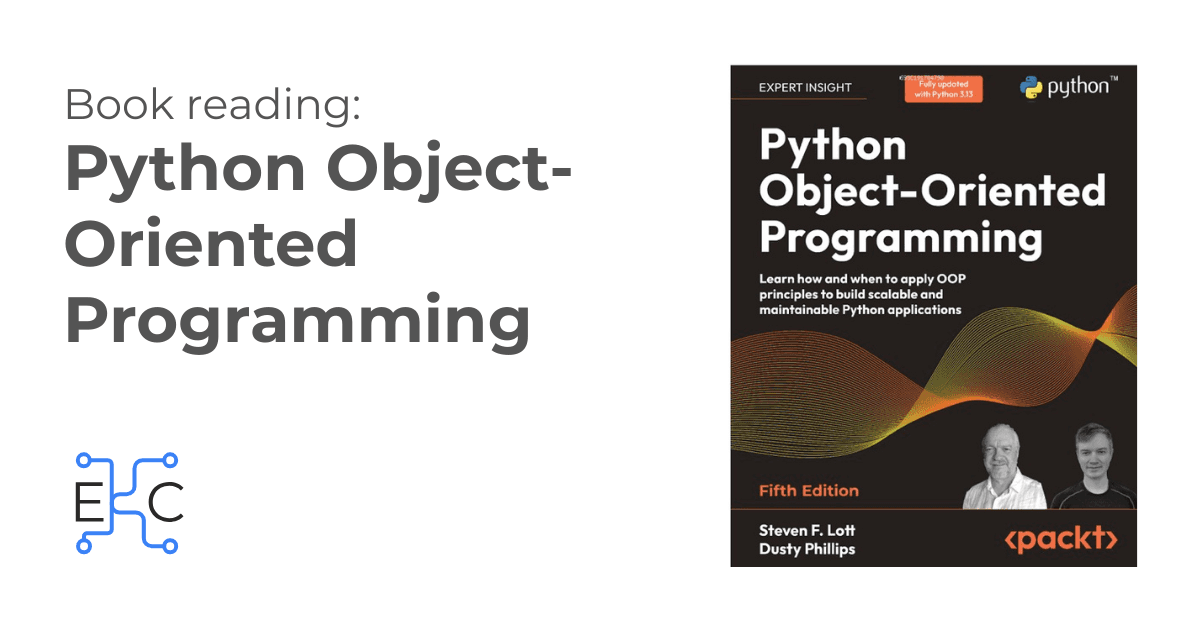
Python Object Oriented Programming
Thanks to Packt Publishing and Vinishka Kalra for the opportunity.
Overall Impression
"Python Object-Oriented Programming" positions itself as a bridge between coding and architecture, aiming to transform intermediate developers into framework designers. The book's strongest asset is its pragmatic philosophy, advocating a "wait until you need it" approach to complexity rather than forcing design patterns where they don't belong. It successfully frames OOP as a design discipline, offering high-value heuristics for creating maintainable software. However, the reading experience is marred by significant editorial errors that require the reader to remain critical throughout the journey.
Depth of Content
On the positive side, the text effectively integrates modern Python features, combining traditional patterns with current typing protocols and testing strategies. This modern integration ensures that the design patterns discussed are relevant to contemporary codebases rather than legacy systems. The authors succeed in showing how OOP fits into the broader ecosystem of modern Python development.
Conversely, the complexity oscillates unpredictably throughout the chapters. Readers may encounter high-level abstraction without supporting code followed by overly dense, outdated examples such as dict subclassing. Additionally, several chapters suffer from truncated logic and omitted recovery strategies, leaving gaps in the implementation details that experienced engineers will notice immediately.
Practical Examples
To demystify abstract concepts, the authors employ cohesive real-world scenarios that generally land well. Analogies involving dice games and IoT systems are used to explain complex topics like metaclasses, making them more accessible than typical academic explanations.
Who Should Read This?
This book is ideal for intermediate Python developers who are proficient in syntax but lack formal software architecture training. It is particularly useful for engineers transitioning to framework design who need to mature their design skills. However, it is unsuitable for beginners who may get lost in the uneven pacing, or experts seeking advanced concurrency topics. Despite its structural flaws, the core architectural advice makes it a worthwhile resource for practitioners willing to filter the content critically.